
Introduction
With increasing concerns about sewage treatment plant performance and environmental pollution, Sequencing Batch Reactors (SBR) have become an essential wastewater treatment technology. SBR is a variation of the activated sludge process that treats wastewater biologically through a time-based sequence of operations within a single reactor tank.
This article explores the origin, operational mechanism, present-day applications, benefits, limitations, and performance enhancement methods of SBR systems. If you require professional assistance in implementing or optimising SBR technology for your facility, feel free to contact us for further information.
Origin and Development of SBR
The idea of batch reactor treatment dates back to the early 1900s, when activated sludge processes were initially introduced. However, modern SBR systems became widely recognised during the 1950s and 1960s, when advancements in automation made sequential control feasible.
During the 1970s, research supported by the Environmental Protection Agency (EPA) in the United States accelerated the adoption of SBR systems. This led to broader implementation in both municipal and industrial wastewater treatment plants.
What is a Sequencing Batch Reactor (SBR)?
A Sequencing Batch Reactor (SBR) is a fill-and-draw activated sludge system that treats wastewater in controlled batches. Unlike traditional continuous-flow systems, SBR carries out all treatment stages within the same tank using timed cycles. This design removes the need for separate tanks for aeration, settling, and clarification.
Main Components of an SBR System
- Influent Tank – Stores incoming wastewater before treatment begins.
- SBR Reactor Tank – The primary tank where biological treatment takes place.
- Decanter – Removes treated water while retaining settled sludge.
- Aeration System – Supplies oxygen to support microbial activity.
- Control System – Automates and regulates the operational sequence.
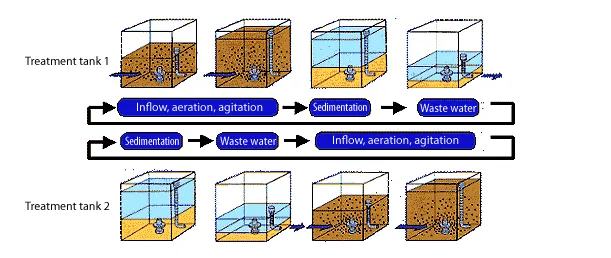
Working Principle: The Five Operational Phases
SBR systems function in repeated cycles, generally comprising five stages:
1. Fill
Wastewater enters the reactor tank.
Mixing ensures even distribution of the organic load.
Aeration may be provided depending on treatment goals.
2. React
Aeration promotes microbial activity.
Microorganisms degrade organic pollutants, reducing BOD, nitrogen, and phosphorus levels.
3. Settle
Aeration is stopped to allow sludge to settle.
Clear treated effluent forms above the settled solids.
4. Decant
The clarified effluent is withdrawn through the decanter, leaving sludge behind.
5. Idle
The system remains inactive until the next cycle begins.
Excess sludge may be removed during this stage for disposal or additional treatment.
Typical Duration of an SBR Cycle
Cycle duration varies depending on wastewater characteristics, treatment objectives, and operational conditions. Generally, one complete cycle lasts between 4 to 8 hours, distributed as follows:
- Fill: 0.5 – 2 hours
- React (Aeration): 1.5 – 4 hours
- Settle: 0.5 – 1.5 hours
- Decant: 0.25 – 1 hour
- Idle: 0.25 – 1 hour
Most systems operate 3 to 6 cycles per day, depending on influent flow and treatment requirements.
Critical Factors to Evaluate Before Finalising Cycle Time
To ensure compliance and efficient performance, the following parameters must be assessed:
Influent Characteristics
- BOD₅ – Indicates organic loading.
- COD – Reflects total oxidisable pollutants.
- TSS – Influences settling behaviour and sludge formation.
- Ammonia (NH₃) & Total Nitrogen (TN) – Essential for nitrification and denitrification processes.
- Phosphorus (P) – Impacts biological phosphorus removal.
- pH & Alkalinity – Affect microbial stability and activity.
Effluent Discharge Standards
Stricter discharge limits for BOD, COD, TSS, nitrogen, and phosphorus may require longer aeration and settling periods.
Sludge and Microbial Characteristics
- Sludge Volume Index (SVI) – Measures settling efficiency.
- Mixed Liquor Suspended Solids (MLSS) – Assists in determining optimal aeration time.
- F/M Ratio (Food-to-Microorganism Ratio) – Maintains balanced microbial growth.
Treatment Objectives
Advanced nutrient removal requires carefully designed aerobic, anoxic, and anaerobic phases.
Hydraulic and Organic Load Fluctuations
Variable influent flow demands dynamic control strategies and possible cycle adjustments.
Aeration and Energy Considerations
Optimising dissolved oxygen (DO) levels helps minimise energy consumption without compromising efficiency.
Current Applications of SBR Technology
SBR systems are widely implemented in both municipal and industrial wastewater treatment plants. They are particularly suitable for:
- Small to medium municipal treatment plants
- Industrial sectors such as food processing, pharmaceuticals, and textiles
- Remote or decentralised facilities
- Plant retrofits requiring process upgrades
- Situations with limited space or fluctuating flow rates
Advantages of SBR Systems
- Space-Saving Design – Combines multiple treatment steps in one tank.
- Operational Flexibility – Adapts easily to varying loads.
- Enhanced Nutrient Removal – Effective nitrogen and phosphorus reduction.
- Cost Efficiency – Reduced infrastructure requirements.
- High Automation – Minimal manual intervention with modern control systems.
Limitations of SBR Systems
- Requires technically skilled operation and proper automation.
- Aeration and mixing may increase energy consumption.
- Sludge bulking can affect settling efficiency.
- Batch operation may not be ideal for very high continuous-flow systems.
Methods to Improve SBR Performance
1. Optimise Cycle Timing
Adjust phase durations according to influent characteristics and load variations.
2. Implement Real-Time Monitoring
Use sensors and SCADA systems to track DO, pH, and nutrient concentrations.
3. Enhance Aeration Systems
Install energy-efficient blowers and fine-bubble diffusers for better oxygen transfer.
4. Maintain Proper Sludge Control
Regular sludge removal prevents bulking and stabilises treatment performance.
5. Apply Advanced Bioculture Solutions
Specialised microbial formulations can improve degradation efficiency and nutrient removal.
6. Upgrade Decanting Systems
Automated decanters reduce sludge carryover and improve effluent clarity.
Conclusion
Sequencing Batch Reactors (SBR) offer a reliable and adaptable wastewater treatment solution. Their compact design and ability to treat diverse effluents make them suitable for both municipal and industrial applications.
However, achieving optimal performance requires careful cycle management, efficient aeration, proper sludge handling, and advanced monitoring systems. With modern automation and biotechnological improvements, SBR technology continues to evolve as a sustainable and efficient wastewater treatment option.
If you are seeking advanced wastewater treatment solutions, including SBR systems, contact us today to discuss the most suitable solution for your facility.
Source – teamonebiotech.com